

We just wrapped JWB’s Q4 2025 Jacksonville Real Estate Market Outlook, an opportunity to step back with both data and perspective to better understand where the market stands today, and what that might mean for investors moving forward.
One detail stood out this quarter: home prices are down 2% year-over-year.
It’s a rare event. Outside of the Great Recession, Jacksonville hasn’t recorded a price decline in more than four decades. At first glance, that can feel unsettling. But when seen in context, it points less to a market in trouble and more to one adjusting in healthy, predictable ways after years of unusual pressure.
Where Things Stand Today
To understand the dip, it helps to look at the bigger picture. Most of Jacksonville’s housing and rental indicators remain steady:
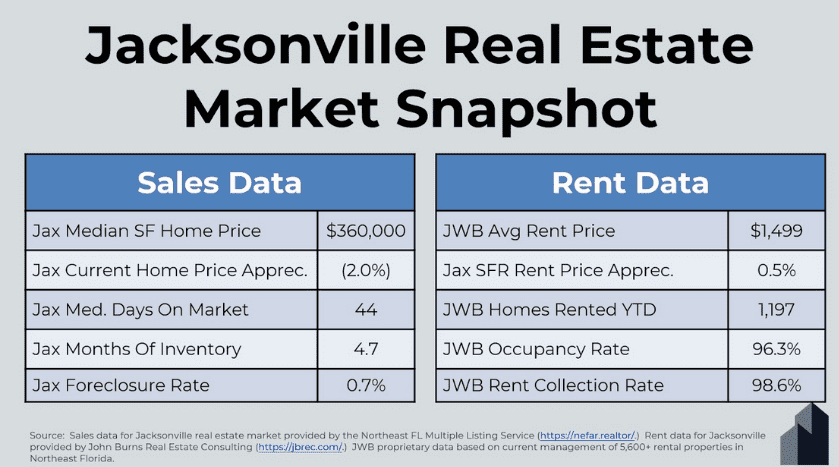
- Median Home Price: $360,000 (–2% YoY)
- Median Days on Market: 44, consistent with normal conditions
- Months of Inventory: 4.7, still shy of the 6–7 months that define balance
- Foreclosures: 0.7%, far below historic averages
- JWB Average Rent: $1,499 (Jacksonville rents have grown 0.5% YoY)
- JWB Occupancy & Rent Collection: 96%+ occupancy & 98%+ rent collection
Taken together, these numbers suggest stability. The small dip in prices is the outlier, and to make sense of it, we need to explore the forces behind it.
👉 Watch the snapshot of Jacksonville’s Q4 numbers and why one detail stands out:
Q4 Jacksonville Market Snapshot: Stability with a Dip
The Why Behind the Dip
The 2% decline in home prices didn’t come out of nowhere. It was shaped by two main forces that have been building for several years:
- Higher interest rates
- Rising inventory levels
What made the difference wasn’t just that rates and inventory climbed, but that they rose so sharply, so quickly, and for so much longer than anyone expected.
Interest Rates:
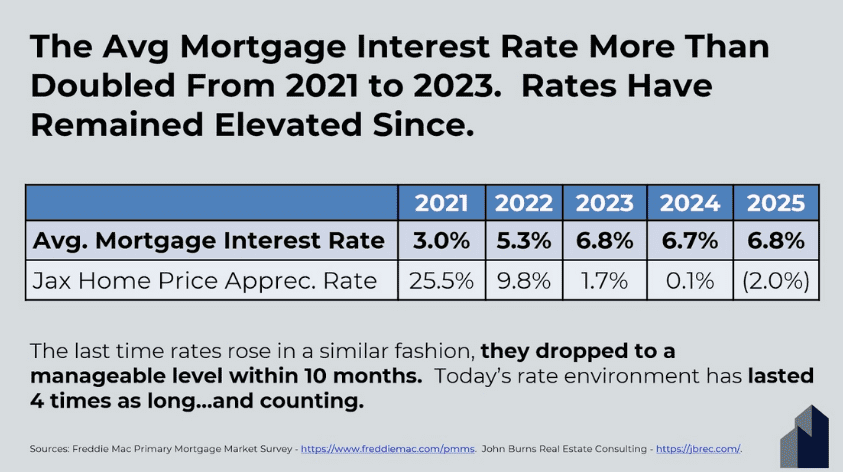
- Mortgage rates more than doubled in just two years, jumping from 3.0% in 2021 to 6.8% in 2023.
- Instead of dropping back within 10 months, as they did in the last time such a rise occurred (40+ years ago), they’ve stayed high for more than three years. That’s four times longer than what happened in the early 1980’s.
However, home prices continued to rise every year from 2021-2024. That reflects incredible resiliency in the Jacksonville real estate market. But eventually, the downward pressure from higher-for-longer interest rates on home sales has led to the temporary price decline we’re experiencing in 2025.
Inventory:
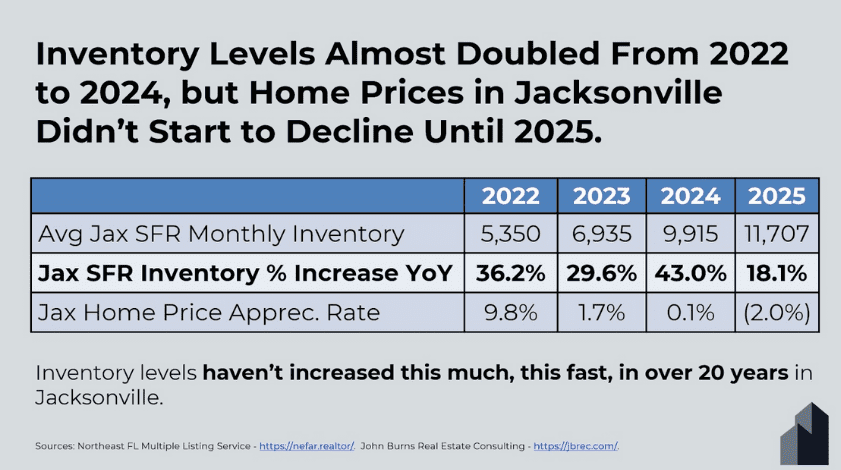
- From 2022 to 2024, single-family home inventory in Jacksonville nearly doubled.
- Monthly averages climbed from 5,350 in 2022 to 9,915 in 2024, the sharpest increase in 20+ years in Jacksonville.
- Even then, home prices held steady until 2025, when inventory pushed past 11,700 and finally began to pull prices down.
Taken together, these two forces created a market environment unlike anything Jacksonville has seen in decades. And the fact that prices only dipped 2% after years of pressure highlights just how resilient the market has been.
👉 See how interest rates and inventory combined to create Jacksonville’s rare 2% price dip:
Why Jacksonville Home Prices Fell in 2025
Not Your Average Insight: A Different Story Than 2008
👉 Today’s market comparison to 2008:
Today’s Market Isn’t 2008 All Over Again
Whenever prices dip, it’s natural to think back to 2008. But the conditions today are fundamentally different.
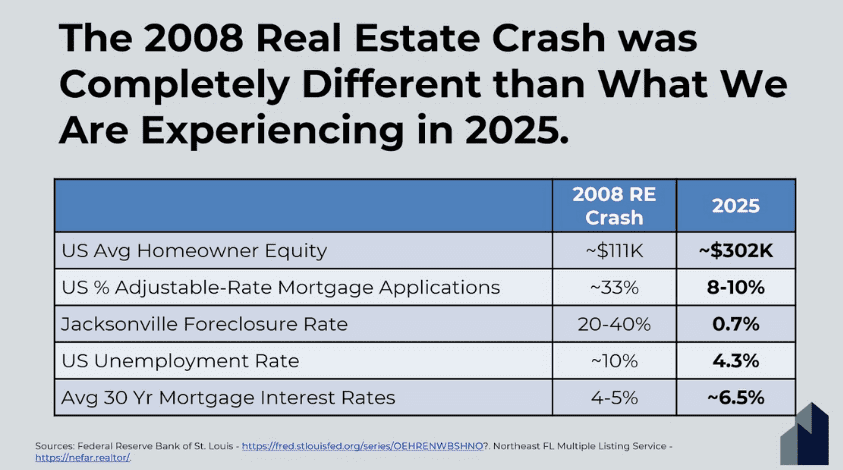
- Equity: The average U.S. homeowner now holds about $302,000 in equity, compared to just ~$111,000 heading into the crash. That’s nearly three times as much security as before, and it makes walking away far less likely.
- Lending Standards: Adjustable-rate mortgages made up ~33% of loans in 2008. Today, it’s closer to 8–10%. Lending is stricter, and buyers are far less exposed to risky products that triggered defaults in the past.
- Foreclosures: Jacksonville’s foreclosure rate is just 0.7% today, compared to 20–40% during the crash. With so few distressed sales, downward price pressure remains limited.
- Employment: U.S. unemployment is 4.3%, less than half of what it was in 2008 (~10%). A stronger labor market helps support steady mortgage payments.
- Rates in Context: Mortgage rates are higher now (~6.5%), but they’re not historically extreme. The difference is that they’ve stayed elevated longer than expected, not that they’re unmanageable.
👉 If there’s one figure to keep in mind, it’s this: the average homeowner today has $300,000 of real, hard-earned equity. That’s a foundation that simply didn’t exist in 2008.
And when we bring it back to first principles, the investor path becomes clearer:
- Cash flow is stronger today than it was a year ago, thanks to slightly lower prices and steady rent growth.
- Jacksonville’s long-term growth, population, jobs, and downtown development remain intact.
Over the years, JWB’s community of long-term investors has seen the rewards of holding steady, with many reaching six-figure profit milestones that once felt far off. Those results came not from chasing quick wins, but from trusting the data and allowing time to do its work.
It’s a reminder that Jacksonville’s market is still anchored by fundamentals: healthy demand, strong equity, and a balanced economy. The 2% dip we see today doesn’t change that story; putting your money in the right market and the right asset, supported by the right team, will always be a path for long-term growth.
Just remember… Don’t Be Average!